Students & Snacks: Feeding The Need

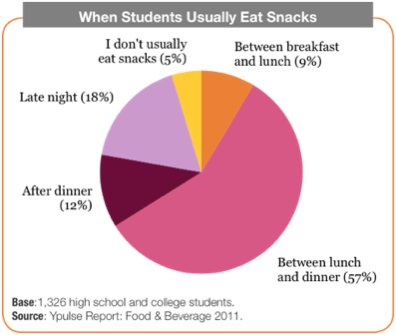
NEW YORK, NY October 10 — Nearly all students, 95percent, indulge in snacks during the day. Students usually eat snacks in the afternoon, between lunch and dinner, but a nearly a third (30%) eat snacks after dinner, according to research conducted by youth marketing research firm Ypulse.
“Coffee shops are their go-to for snacks,” says Melanie Shreffler, editor-in-chief of Ypulse, a leading authority on youth culture and marketing. In the prior week, 24% of students stopped in to Starbucks, 22% or Dunkin Donuts, and 13% to a local coffee shop to pick up a snack, compared with 21% who stopped in to McDonald’s.
But their snacking preferences depend on age and time of day. High schoolers have a slight preference for fast food restaurants; collegians are partial to coffee houses, which is tied to their coffee drinking habits. High schoolers have little interest in coffee, while college students are beginning to make it part of their daily routines.
Coffee houses are a daytime venture, and students switch to fast food at night. In the prior month, 42% of students (particularly girls and college students) went to coffee shops for a mid-day snack, compared to only 13% who did so for an after-dinner snack. Some 28% of students (particularly boys and high schoolers) went to fast food spots for daytime snacks, 30% for nighttime snacks.
“For high schoolers, fast food restaurants are not only readily accessible, they’re familiar. They’ve been eating there since they were kids. When they get to college, students have more options and try new things,” said Ypulse’s Shreffler. “They start drinking coffee more regularly and are more comfortable experimenting with menu items, from lattes to cappuccinos. Grabbing a snack while they’re there saves them time.”
Methodology: The results of the Ypulse Report: Food & Beverages 2011 are drawn from 1,326 interviews conducted among members of the SurveyU panel between July 14 and July 25, 2011.
Respondents for this survey were selected from among those who have registered to participate in surveys for SurveyU, a Ypulse-owned online research panel. Quotas were established based on gender, state, class year, and race. The data have been weighted using National Center for Education Statistics (NCES) data to reflect the demographic composition of U.S. high school and college students.
Because the sample is based on those who initially self-selected for participation in the panel rather than a probability sample, no estimates of sampling error can be calculated. All sample surveys and polls may be subject to multiple sources of error, including, but not limited to sample error, coverage error, and measurement error.
October 10, 2011